

If you run an agency, AI search visibility has stopped being a nice-to-have. Clients now ask where they show up in ChatGPT, Google’s AI Overviews, and Perplexity — and you need a defensible answer for every account on your roster. Ahrefs Brand Radar is one of the first tools to take that question seriously, so the real evaluation isn’t “does it track AI mentions?” It’s whether it tracks them in a way an agency can scale across many clients and put in front of them.
Ahrefs Brand Radar is one of the first tools built specifically to track brand mentions across AI platforms like ChatGPT, Perplexity, and Google’s AI Overviews — and because it lives inside the Ahrefs suite, a lot of agencies already have access to it.
This is a Brand Radar review written for agency buyers — not for in-house brand teams watching a single domain. We’ll give Ahrefs honest credit where it earns it, and be direct about where the product fights the agency workflow.
The agency verdict: Brand Radar is a genuinely useful research database for understanding how AI systems mention a brand, and during its beta it’s been remarkably good value. But it’s built as an exploratory tool inside the Ahrefs ecosystem, not as a multi-client AI visibility tracker with white-label client reporting. For an agency that needs to monitor and prove AI visibility across a roster — and brand the output — it’s a strong signal of where Ahrefs is heading, not yet the platform you’d run client reporting on.
Where Brand Radar Helps Agencies
Let’s lead with what’s actually good, because an honest agency review has to credit it.
Brand Radar is one of the first comprehensive AI tools designed to track brand mentions across multiple AI platforms. Unlike traditional brand-monitoring tools that focus on web content, it ventures into AI-generated responses — territory that was previously impossible to measure at scale.
For agencies already living in Ahrefs, the integration is the headline benefit. AI citation data appears inside Site Explorer, with dedicated Search Demand and Web Visibility modules, so you can view AI mention data alongside the traditional SEO metrics you already pull for clients. That single-pane view is convenient when you’re assembling a client picture.
The data quality is solid for what it captures. Agencies report that the Search Demand and Web Visibility modules track “fairly accurately,” capturing both linked and unlinked brand mentions and reflecting real interest trends. Its read on Google’s AI Overview mentions has earned positive feedback for giving a realistic, directionally useful figure, and there’s a notable absence of false-positive complaints — the prompts it surfaces are real prompts, not manufactured data.
For competitive work, that’s valuable. You can discover which questions trigger a client’s brand mentions and which competitor content AI systems cite most often — exactly the kind of intelligence that informs a content strategy across AI search platforms.
Where Brand Radar Falls Short for Agencies
None of that means Brand Radar fits the agency model cleanly. The gaps show up the moment you try to run it across a client roster.
It’s a research database, not a client tracker
Brand Radar functions more as an exploratory research database than a straightforward rank tracker, which initially confuses teams expecting a monitoring dashboard. That paradigm is fine for ad-hoc investigation, but agencies need repeatable, account-by-account tracking they can check weekly and hand to a client. Building a recurring client-reporting rhythm on top of an exploratory tool is friction you feel on every account.
Sampling completeness is still a beta question
As a beta product, the most significant limitation is the comprehensiveness of its AI content tracking. Current sampling appears to capture only a fraction of actual AI conversations, which makes some agencies hesitant to present the numbers as definitive to a client. Ahrefs has acknowledged the UI “still needs work” and promised improvements, but until coverage and interface mature, you’re managing client expectations around early-stage data.
No optimization workflow
Brand Radar tells you where you’re mentioned. It doesn’t help you do the work to get mentioned more — no briefs, no content scoring, no handoff to writers. For an agency, monitoring is step one; the value is in closing the gap it surfaces, and that part lives outside the tool.
No white-label or multi-client reporting layer
This is the big one for agencies. Brand Radar surfaces insights inside the Ahrefs interface, but there’s no built-in white-label reporting for agency delivery — no branded, client-ready output you can send without manual assembly. For a single brand team that’s irrelevant. For an agency proving AI visibility to twenty clients, reporting is the entire deliverable, and it sits outside the product.
It rides the same per-seat economics
Brand Radar lives inside Ahrefs, which means it inherits Ahrefs’ per-seat pricing and project caps once the beta ends. The cost question for AI visibility is the same one agencies hit across the platform: your bill scales with headcount and client count, not with results.
The G2 and AEO Angle
Two trends make Brand Radar relevant beyond pure SEO. First, AI Overviews and chatbot answers increasingly lean on third-party signals — review platforms like G2, listicles, and “best of” roundups — when they recommend tools and brands. Tracking AI mentions surfaces which of those sources are feeding the answers about your client. Second, this is the core of answer engine optimization (AEO): you can’t optimize for AI answers you can’t see, so a monitoring layer is the entry point to the whole discipline.
Brand Radar is a solid way to see that landscape. The gap is everything that comes after seeing it — diagnosing why a competitor is cited and your client isn’t, then shipping the content and citations that change it.
Brand Radar Pricing for Agencies
During its beta, Brand Radar’s most attractive feature has been its inclusion across all Ahrefs subscription plans at no extra cost — accessible even on the entry-level $129/month Lite plan. For agencies, that’s been a low-risk way to experiment with AI brand monitoring across a few accounts.
The catch is that it will eventually become a paid add-on layered on top of Ahrefs plans that already price by seat and cap projects. When that happens, the per-client math matters more than the sticker price. If you’re weighing what AI visibility tracking should actually cost across a roster, it’s worth reading how much you should pay for AI search visibility tracking tools before committing.
If you’re weighing the broader set of monitoring tools, our Ahrefs Brand Radar alternatives guide breaks down where each one fits, and our Ahrefs alternatives roundup covers the wider suite if you’re rethinking your whole stack.
Choose Brand Radar If / Choose Rankability If
Different agency profiles should make different calls.
Choose Brand Radar if:
- Ahrefs is already your core platform and you want AI mention data in the same interface as your SEO research.
- Your need is exploratory competitive intelligence — discovering prompts and citation patterns — more than recurring client reporting.
- You’re comfortable presenting early-stage, sampled AI data as directional rather than definitive.
Choose Rankability if:
- You need to track AI visibility across many clients and report on it on a repeatable schedule, not investigate it ad hoc.
- Client deliverables require branded, white-label output without manual assembly.
- You want AI visibility measured alongside traditional rankings in one AI search reporting feature built for agency delivery.
Brand Radar vs Rankability for Agencies
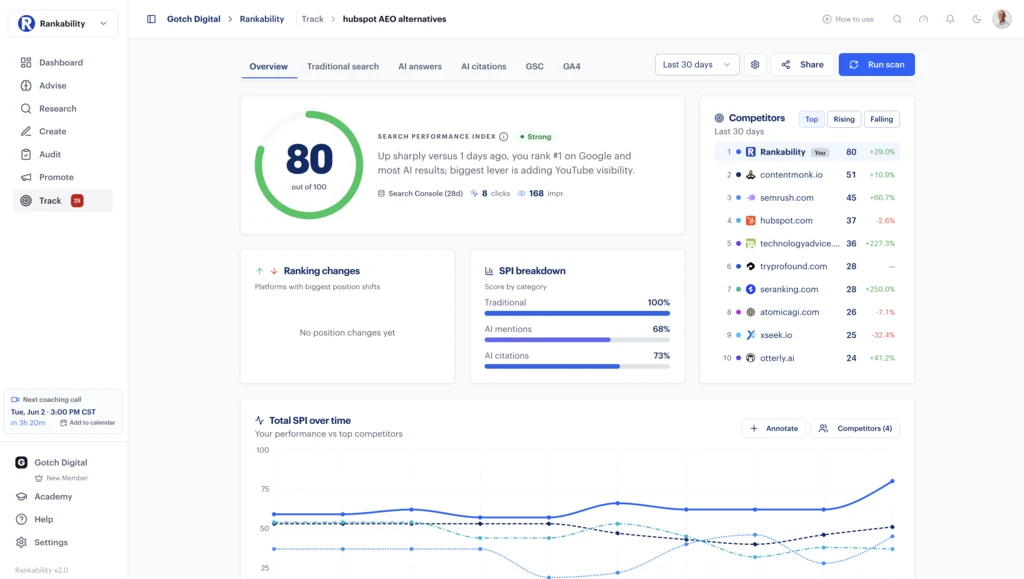
This is where the agency fit diverges. Brand Radar is a monitoring module inside a research suite. Rankability Tracker is an SEO and AI-visibility platform built around how agencies actually deliver work — tracking how each client shows up across AI search engines and Google’s AI Overviews, then turning that into client-ready reporting.
| Capability | Ahrefs Brand Radar | Rankability |
|---|---|---|
| AI mention tracking (ChatGPT, Perplexity, Gemini) | Yes (beta sampling) | Yes |
| Google AI Overview tracking | Yes | Yes |
| Unified score clients understand | No | SPI score across traditional + AI search |
| Content optimization workflow | No | Briefs, drafts, real-time scoring |
| Close-the-loop (see gap → fix gap) | Diagnosis only | Diagnosis + execution in one workflow |
| White-label client reporting | No | Built into every plan |
| Multi-client workspaces | No | Yes |
| Pricing model | Ahrefs plan + eventual add-on | Unlimited clients and users from $99/mo |
The practical difference: with Brand Radar you find out a client is invisible in AI answers, then leave the tool to do something about it. With Rankability the same gap flows straight into a content brief, a draft scored against live results, and a branded report the client can read — without switching tools or stitching together exports. If you’re rethinking your stack entirely, our guide to our Ahrefs review breaks down where it falls short.
Is Brand Radar Worth It for Agencies in 2026?
Conditionally, yes. If Ahrefs is already your hub and you want early AI mention data for competitive research, Brand Radar deserves credit for being among the first to tackle AI brand monitoring systematically, and it’s worth exploring while the beta keeps it inexpensive.
But “worth it” changes the moment your need becomes multi-client tracking and white-label client reporting. At that point you’re using an exploratory research tool to do a recurring delivery job it wasn’t designed for. That’s the line where most growing agencies pair Brand Radar with — or replace it with — a platform built for AI visibility reporting at agency scale.
Explore the Ahrefs Cluster
If you’re evaluating Ahrefs across its products for agency use, these companion reviews go deeper:
- Ahrefs review for agencies — the per-seat cost, seat-sharing limits, and project caps, reviewed for agency buyers.
- Ahrefs AI Content Helper review — its AI content optimizer, tested for agency content teams.
Frequently Asked Questions
Is Ahrefs Brand Radar good for agencies?
It’s a strong research tool for understanding how AI systems mention a brand, and it’s well-integrated into the Ahrefs ecosystem. For agencies, the limitation is that it’s an exploratory database rather than a multi-client tracker with white-label client reporting, so it fits competitive research better than recurring client delivery.
How much does Brand Radar cost?
During its beta it has been included across all Ahrefs plans at no additional cost, starting from the $129/month Lite plan. Ahrefs has signaled it will become a paid add-on, at which point it inherits Ahrefs’ per-seat and per-project economics — the part agencies should price out across their roster.
Can Brand Radar replace a dedicated AI visibility tracker for clients?
Not yet for most agencies. Its sampling captures a fraction of AI conversations and it has no built-in branded reporting, so agencies that need to prove AI visibility per client on a schedule usually run a dedicated AI search reporting tool alongside or instead of it.
What’s the best Brand Radar alternative for agencies?
For agencies that need multi-client AI visibility tracking with white-label reporting, Rankability is the closest agency-built option. See the full Brand Radar alternatives list (linked above) for other tools.
Free GEO Checklist – Download the complete 97-point checklist to optimize your brand for AI-powered search engines like ChatGPT, Gemini, and Perplexity.