

You’re here because you’re looking for Ahrefs alternatives, and you’re probably like a lot of other people who have searched for this.
I wanted to know why people actually leave Ahrefs, so I didn’t start with a list of software. I started with 163 one- and two-star Ahrefs reviews on Trustpilot (May 2018 to September 2026) and sorted every complaint by theme. Here’s what came up most:
- You keep running out of credits. 47% of the reviews complain about credits, report limits, or row limits. People describe filters, refreshes, and toolbar lookups eating credits they assumed were unlimited.
- The price keeps going up. 30% mention price. Many are long-time customers who were moved off legacy plans and saw their bill double or worse.
- You got locked out for “suspicious activity.” This is the fastest-growing complaint. 10 of the 17 reviews posted in 2026 describe a paid account being restricted for working “too fast,” sometimes for one to two weeks.
- You don’t trust the traffic numbers. Several reviewers compared Ahrefs traffic estimates to their own analytics and found gaps of 20x or more.
- Support couldn’t help, and refunds were denied. 28% mention support. Ahrefs’ own replies confirm that automated restrictions can’t be lifted manually by support.
- You need agency features Ahrefs doesn’t focus on: local rank tracking, client-ready reporting, white-label, and AI search visibility across ChatGPT, Gemini, Perplexity, Google AI Overviews, and Google AI Mode.
If any of those sound like you, you’re in the right place. Today I’m going to show you 15 of the best Ahrefs alternatives for agencies in 2027, organized by the job you were using Ahrefs to do. If you’re a solo site owner, you’ll still find the cheaper and free options you need.
Your decision will largely depend on your budget and technical expertise, but I’m going to give you options for every scenario. I’ll also show you where the AI answers from ChatGPT, Gemini, Perplexity, and others get these tools wrong, because several of them are quoting prices that are already out of date.
Let’s dive right in.
Quick Answer: The Best Ahrefs Alternatives by Job
| If you used Ahrefs for… | Best alternative | Why | Starting price |
|---|---|---|---|
| Agency delivery: AI visibility, content, and client reporting | Rankability | Tracks 11 AI platforms plus Google and the local pack, creates and optimizes content from Google and AI answer research, and delivers white-label reports | $97/mo |
| Everything (closest 1:1 swap) | Semrush | Closest feature match. Keywords, backlinks, audits, rank tracking, PPC, and AI visibility in one platform | $139/mo ($117.33/mo annual) |
| Everything, on a budget | SE Ranking | Comparable core toolset with a 14-day no-card trial | $129/mo ($103.20/mo annual) |
| Backlink research only | Majestic | Dedicated link index with Trust Flow, Citation Flow, and history back to 2006 | $49.99/mo |
| Backlinks without usage caps | SEO PowerSuite | Desktop software you license, not a per-click credit system | Check current pricing |
| Keyword research on a budget | Mangools | KWFinder is the easiest keyword tool to learn | Check current pricing |
| Competitor PPC and ad history | SpyFu | Years of competitor keyword and ad history | Check current pricing |
| Technical site audits | Screaming Frog | The standard desktop crawler. Free up to 500 URLs | Free / $279/yr |
| Content creation and optimization | Rankability (agencies), Surfer SEO or Clearscope (scoring only) | Rankability researches Google and AI answers and drafts in the client’s voice. Surfer and Clearscope score drafts while you write | $97/mo / $49/mo / $129/mo |
| Traffic and market intelligence | Similarweb | Built for traffic estimates, which is where Ahrefs gets the most criticism | Check current pricing |
| Your own site’s real data | Google Search Console | First-party clicks, impressions, and indexing data Ahrefs can’t access | Free |
Prices verified on each vendor’s pricing page on October 10, 2026, unless noted. Prices change often, so check before you buy.
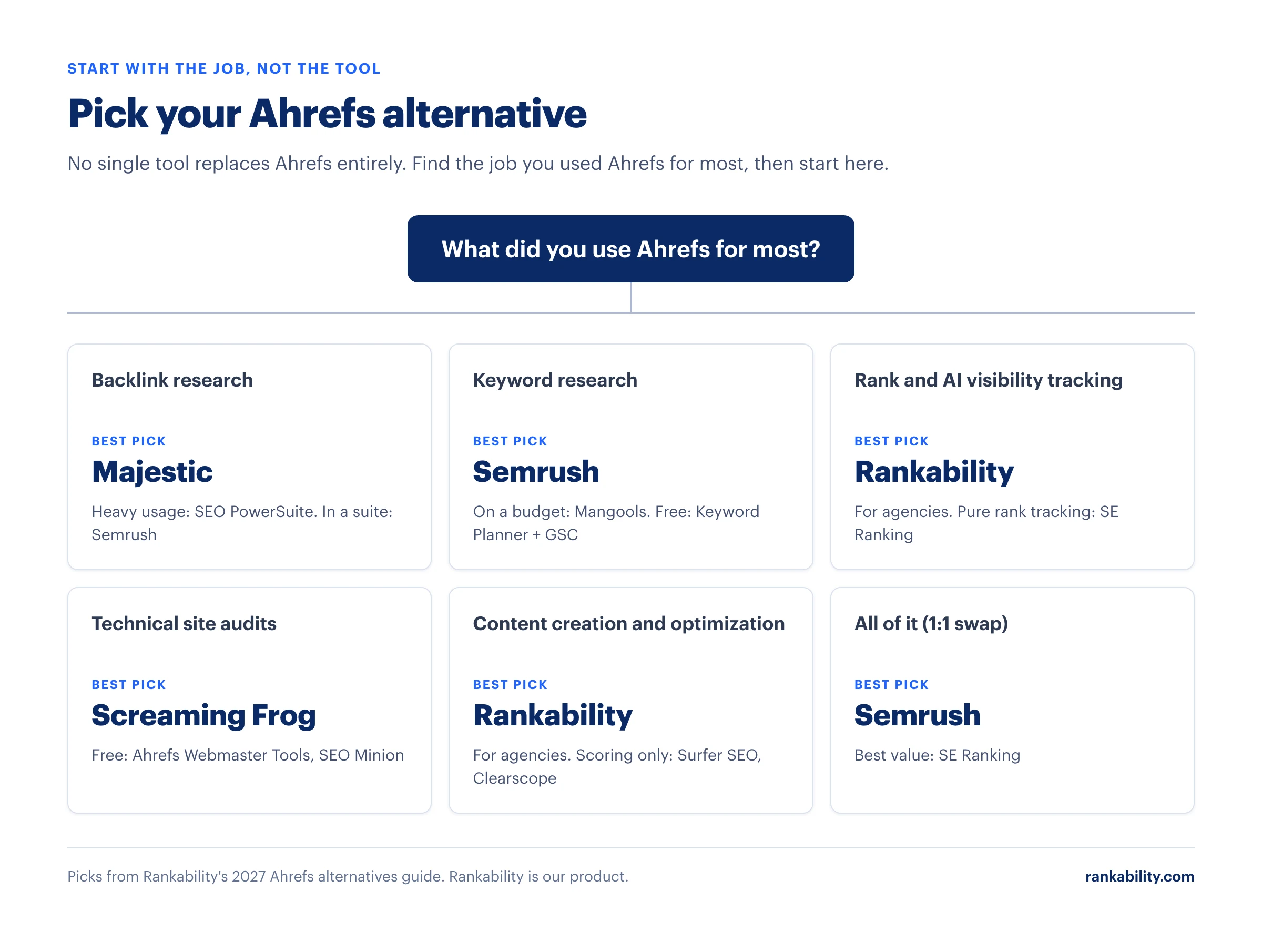
Start with the job you used Ahrefs for most.
Why People Actually Leave Ahrefs (What 163 Negative Reviews Say)
Let me be upfront about the data first. I analyzed 163 reviews, and they’re all one or two stars. That’s a filtered set, so it tells you what goes wrong for unhappy users. It doesn’t tell you how most Ahrefs customers feel. Ahrefs is still one of the strongest SEO data platforms in the world, and I’ll say where it’s still the better choice.
But if you’re already frustrated, these patterns will help you avoid jumping to a tool with the same problem.
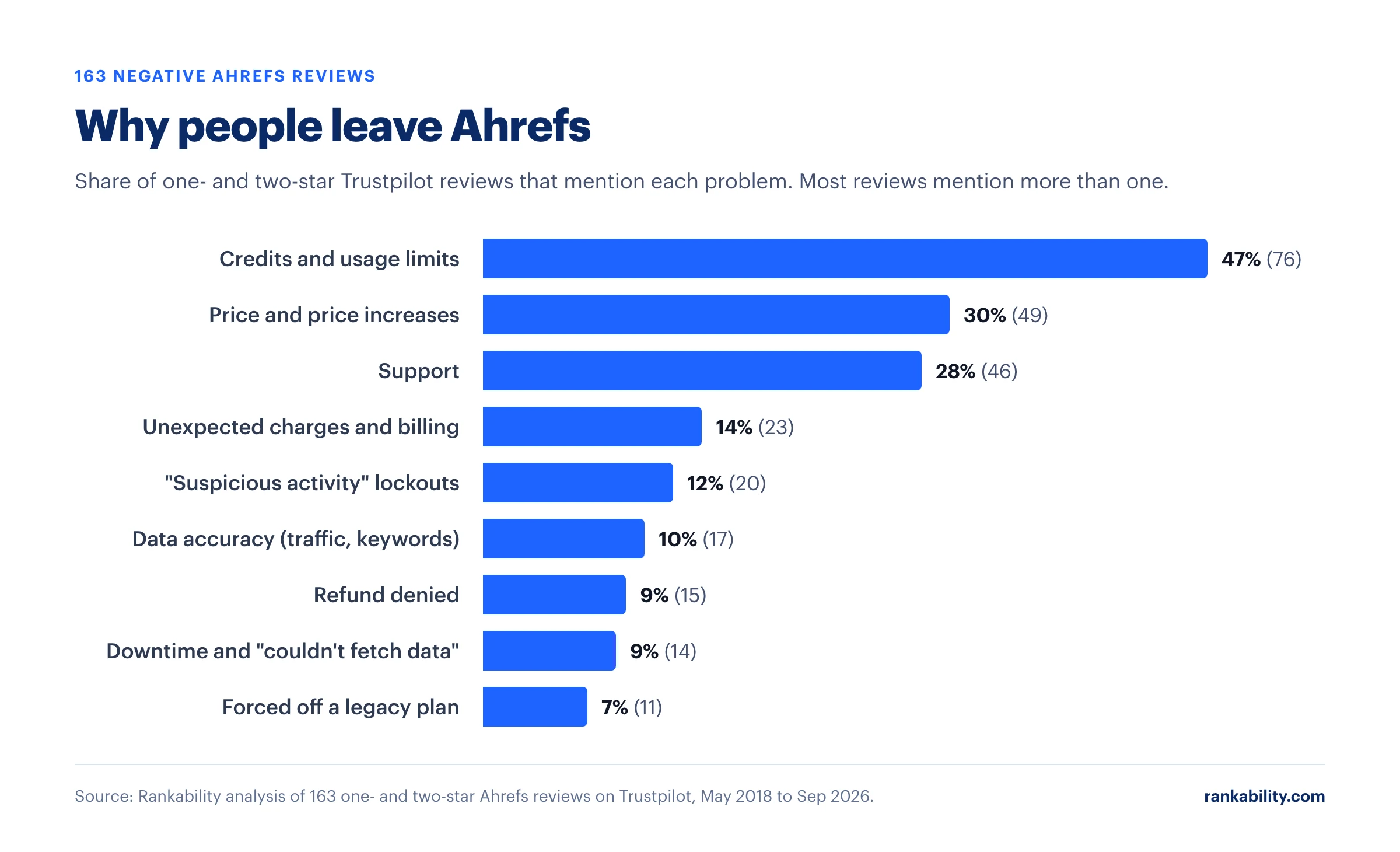
What 163 one- and two-star Ahrefs reviews complain about. Most mention more than one problem.
Problem 1: Credits and usage limits (76 of 163 reviews)
This is the biggest complaint by far, and it started in 2022. Ahrefs introduced its credit system in Q1 2022 (Ahrefs confirmed this date in its own Trustpilot replies). Complaints about credits went from 14 reviews in 2022 to 20 in 2023 and 22 in 2024.
The details matter here. Ahrefs confirmed in a reply that applying filters consumes credits, because each filter is a new database query. Reviewers described burning through a month of credits in 20 minutes, two days, or one week of normal research. Several said they couldn’t even open keyword lists they’d already built until the monthly reset.
Today, Ahrefs Lite ($129/mo) includes 1,000 credits per user. Standard ($249/mo) and above have “unlimited” credits. Which brings us to problem 2.
Problem 2: “Suspicious activity” lockouts on unlimited plans (20 reviews, 10 in 2026 alone)
When Ahrefs removed credits from Standard plans and up, the complaint didn’t disappear. It changed shape.
Unlimited plans are subject to a fair use policy. In its replies, Ahrefs says restrictions are applied automatically when activity “significantly exceeds typical human usage patterns,” that it won’t disclose the exact triggers, and that support can’t manually lift them.
The reviewers describing this aren’t running scrapers. They’re people doing expired domain research with Batch Analysis, agencies checking client domains, and one person who says they checked five domains on a $1,000/month plan. Lockouts reportedly lasted from a few hours to two weeks, with no prorated refund.
What this means for you: if you do high-volume work (domain research, link prospecting, agency audits across many clients), you need a tool with published limits, not a fair use policy you can’t see.
Problem 3: Price increases and forced plan changes (49 reviews)
The second wave of complaints came from loyal customers. Eleven reviewers described being moved off legacy plans, with bills going from $99 to $250, £94.80 to £190.80, and in one case $190 to $650 per month. One reviewer lost Batch Analysis on their grandfathered plan, which effectively forced an upgrade.
There are smaller costs too. Team seats aren’t included beyond the first user, and extra seats run $40 to $80 per user per month depending on the plan. Brand Radar AI, Ahrefs’ AI visibility product, starts at $199/mo on top of your plan. Ahrefs Lite includes just 5 tracked AI prompts.
Problem 4: Traffic estimates people don’t trust (17 reviews on data accuracy)
This one gets the most heated reviews. Examples from reviewers:
- A site with 870k visits shown as under 400.
- A site with 150k monthly visits shown as 8k.
- A client site with 300k organic pageviews shown as 800.
- A US-focused business shown as 70% Indian traffic.
To be fair to Ahrefs, its replies are clear that traffic figures are organic-only estimates built from keyword rankings. They aren’t measurements, and they’re meant for comparison and trend research. Every third-party tool estimates traffic this way, including Semrush and Similarweb.
The real lesson: no Ahrefs alternative will give you accurate traffic for a site you don’t own. For your own sites and your clients’ sites, use first-party data from Google Search Console and GA4. For competitors, use estimates for direction, never for pricing a deal.
Problem 5: Support, refunds, and billing (46 support, 15 refund, 23 billing reviews)
The recurring issues:
- Refunds denied once you’ve used the product. One agency owner tested Ahrefs as a Semrush replacement, found gaps in local data and client reporting, and was refused a refund because they had used it. Ahrefs has no free trial (it confirmed this in a reply), so you can’t evaluate it before you pay.
- Limited payment options. Ahrefs confirmed PayPal isn’t supported and bank transfers are Enterprise-only.
- Downtime. 14 reviews describe “couldn’t fetch data” errors or outages, and one 2026 reviewer quoted a SERP data issue Ahrefs acknowledged for several weeks.
How the complaints shifted over time
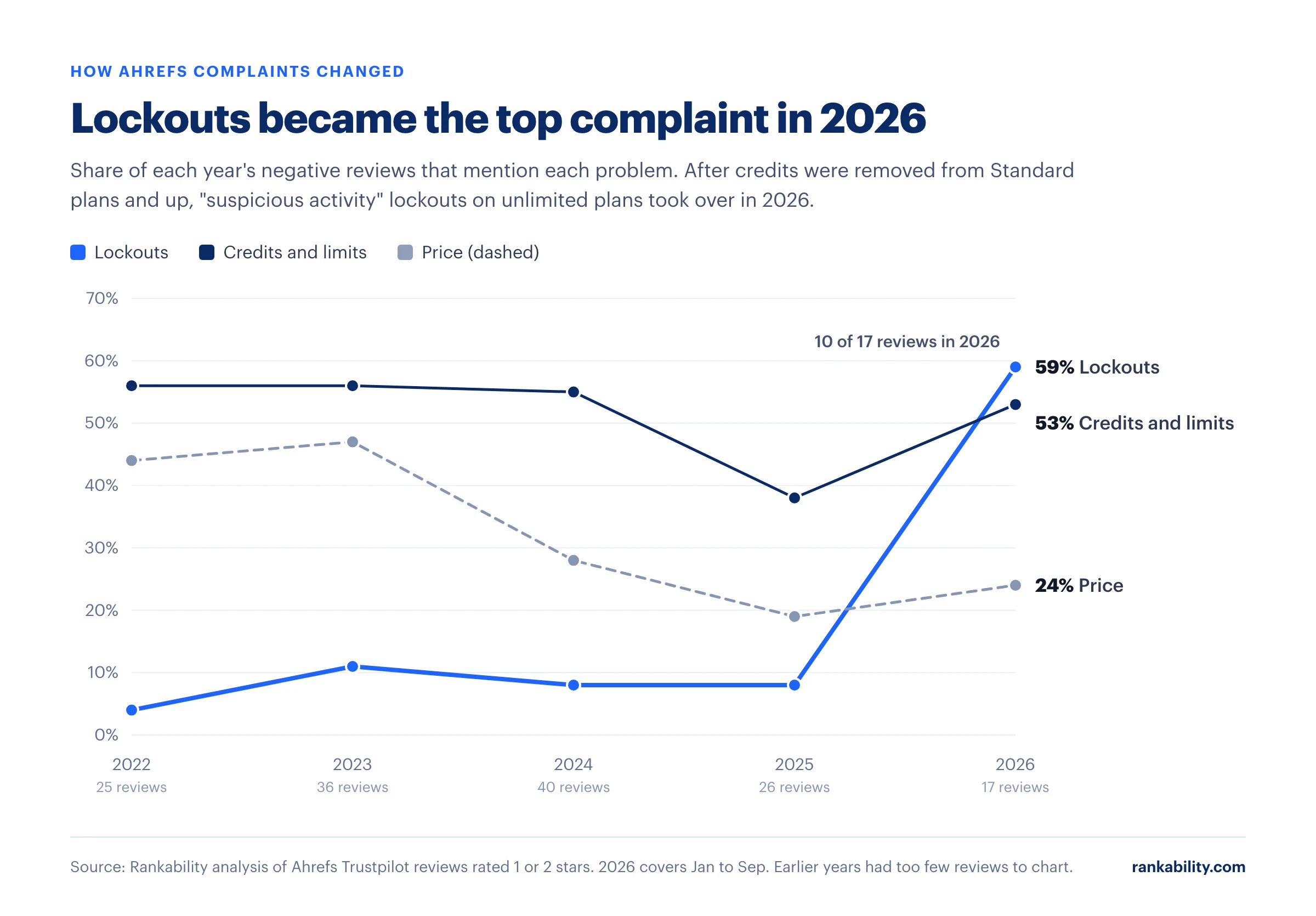
Lockouts went from a minor complaint to the most common one in 2026.
| Period | Top complaint | What changed |
|---|---|---|
| 2020 to 2021 | Payment processor problems, trial issues | Checkout problems and a $7 trial that was later removed |
| 2022 to 2024 | Credits and price increases | Credit system launched in Q1 2022, legacy plans retired |
| 2025 | Credits and support | Credits removed on Standard+; complaints dip but don’t disappear |
| 2026 (Jan to Sep) | “Suspicious activity” lockouts (59% of reviews) | “Unlimited” plans enforced by fair use limits that aren’t published |
If you’re switching to escape one of these problems, make sure the new tool doesn’t have the same one. I’ll flag that for each alternative below.
Before You Switch: No Single Tool Replaces Ahrefs Entirely
This is the most useful thing I can tell you, and almost every AI answer I analyzed agrees: no single tool replaces Ahrefs entirely.
Ahrefs does five jobs: backlink analysis, keyword research, rank tracking, site audits, and content. Most alternatives are excellent at one or two of those. So before you pick a tool, answer one question:
Which Ahrefs job do you actually use every week?
Then use this table to match your problem to the fix:
| Your Ahrefs problem | What to look for | Alternatives that fit | Watch out for |
|---|---|---|---|
| Running out of credits | Published, generous limits | Semrush, SE Ranking, Screaming Frog (paid licence) | Search Atlas also uses a credit pool (50,000 “Universal Credits” on Starter) |
| Lockouts on heavy use | Desktop or licensed software | SEO PowerSuite, Screaming Frog | Every cloud tool has some fair use policy. Ask for limits in writing |
| Price | Lower entry price or free tools | Mangools, Ubersuggest, Moz Pro, GSC + Keyword Planner | Cheaper tools have smaller databases |
| Traffic accuracy | First-party data | Google Search Console, GA4, Bing Webmaster Tools | Every third-party tool estimates competitor traffic |
| Agency reporting and local | White-label, local pack, client workflows | SE Ranking, Rankability | White-label is an add-on on some plans |
| AI search visibility | Multi-platform AI tracking | Rankability, Semrush, SE Ranking | Prompt limits vary widely by plan |
| No trial or refund | Free trial or money-back window | SE Ranking (14 days, no card), Semrush (7 days), Clearscope (14 days), Majestic (7-day money back) | Check each refund policy before you subscribe |
How I Chose These Alternatives
I wanted this list to be grounded in evidence, not affiliate payouts. Here’s what I used:
- 163 negative Ahrefs reviews from Trustpilot, sorted into complaint themes. (Two reviews were about an unrelated job scam that impersonated Ahrefs, and I ignored them.)
- AI answers from 9 platforms (ChatGPT, Claude, Gemini, Perplexity, Grok, Microsoft Copilot, DeepSeek, Google AI Overviews, and Google AI Mode), captured October 6, 2026, for the query “Ahrefs alternatives.” I logged every tool they recommended and every claim they made about it, using Rankability Tracker’s answer analysis.
- Vendor pricing pages, checked October 10, 2026.
The AI answers were remarkably consistent on which tools to recommend. Semrush, SE Ranking, and Mangools appeared in all 9. Ubersuggest appeared in 8, and Google Search Console and Moz Pro showed up in most.
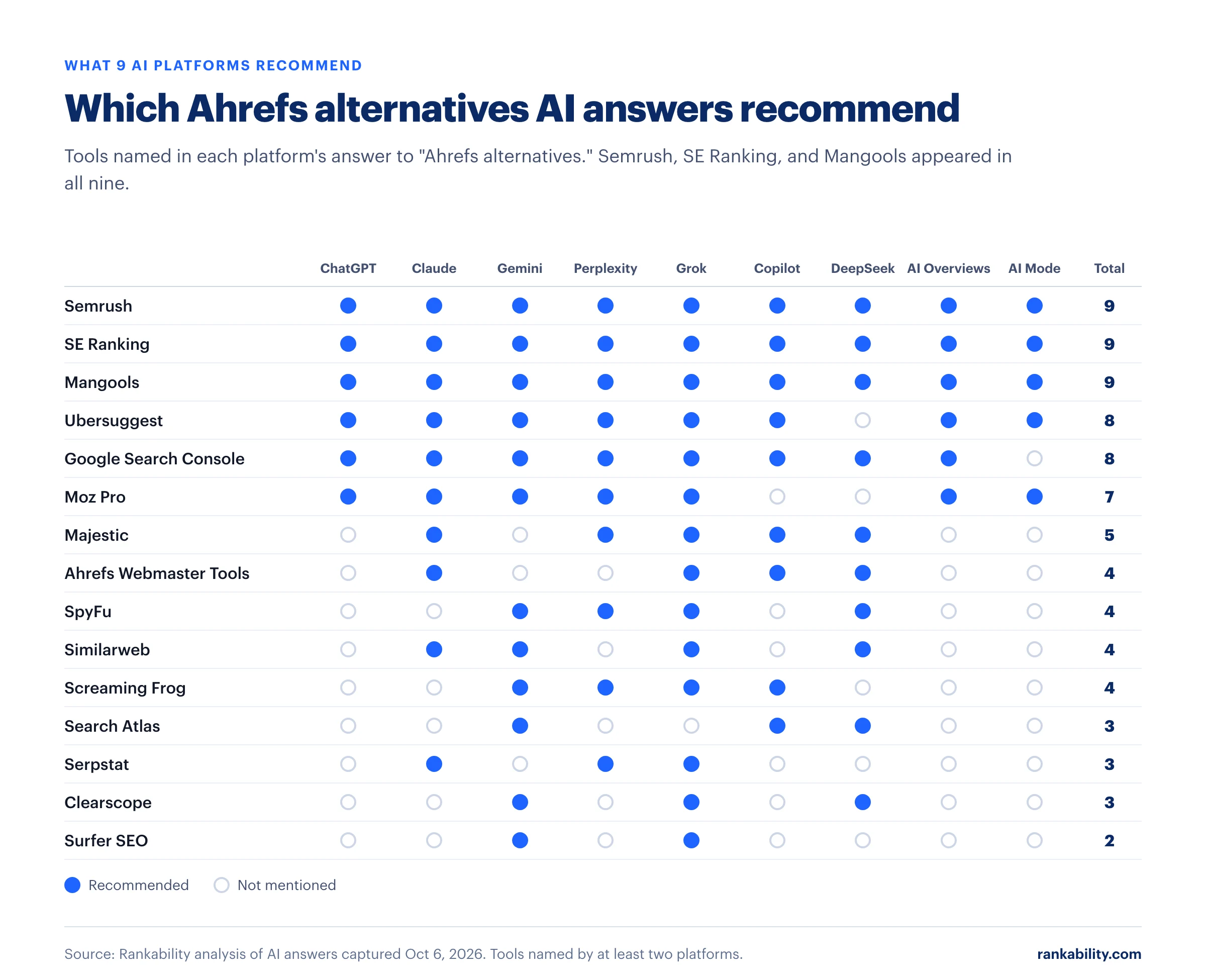
Which tools each AI platform named, captured October 6, 2026.
But the AI answers were often wrong on details:
- SE Ranking’s price. AI answers quoted $44 to $65 per month. SE Ranking’s current entry plan is $129/mo ($103.20/mo billed annually).
- Mangools’ rank tracking. Copilot said Mangools’ daily rank updates beat Ahrefs. Mangools’ own site says SERPWatcher updates weekly, with daily updates only on the Agency plan.
- Search Atlas and credits. Copilot recommended Search Atlas to people frustrated by Ahrefs credits. Search Atlas runs on a shared monthly credit pool.
- Backlink index sizes. AI answers cited figures like “100 trillion backlinks” (Search Atlas), “43 trillion” (Semrush), and “40 trillion” (Majestic). These are vendor marketing numbers. They aren’t measured the same way and shouldn’t decide your purchase.
So if you’ve been asking ChatGPT for an Ahrefs alternative, double-check the price and limits on the vendor’s site.
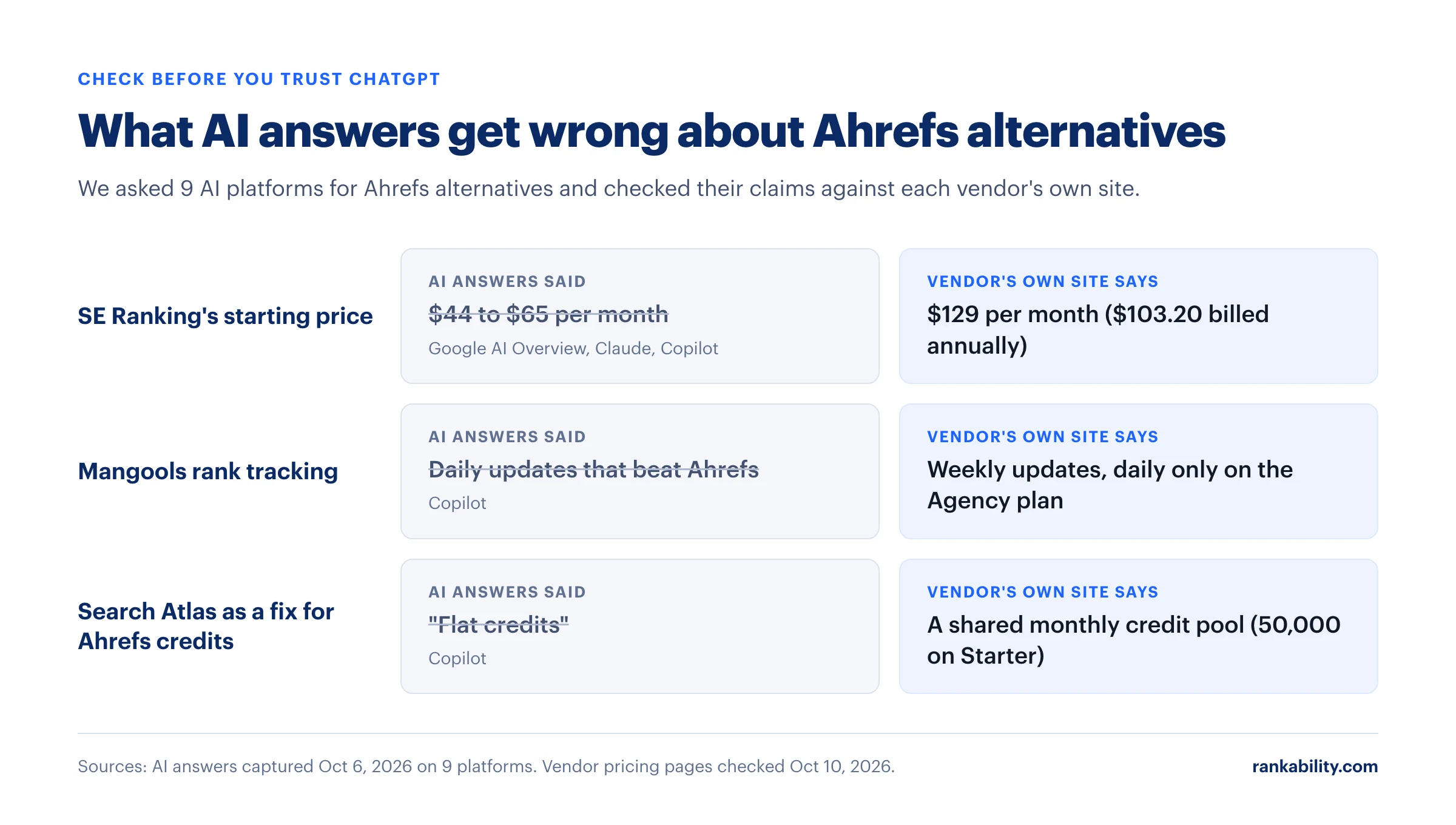
Three claims AI answers got wrong, checked against each vendor’s site.
Now let’s get into the alternatives, job by job.
If You Want One Tool to Replace All of It
Most agencies should still read the job-specific sections below. But if you want one all-in-one SEO toolkit that covers most of what Ahrefs does, these are your options.
1. Rankability: Best for agencies (AI search visibility, content, and client delivery)
Best for: Agencies managing multiple clients across Google, the local pack, and AI search. Starting price: Starter $97/mo. Agency $297/mo. Agency Pro $497/mo.
Full disclosure: this is our product, so weigh my opinion accordingly. I’ll tell you where it’s weaker, too.
Ahrefs is a data tool. One reviewer, a six-year customer, described following Ahrefs data to create content and build links and getting no rankings or traffic. Ahrefs replied, fairly, that it’s a data tool, not a guarantee of rankings.
That’s the gap Rankability is built for. It doesn’t stop at data. It tracks your clients, finds the gaps, and helps you do the work that closes them.
1. It tracks where your clients actually show up. Rankability Tracker monitors your clients on 11 AI platforms (including ChatGPT, Claude, Perplexity, and Gemini) every day, alongside Google rankings and the local pack. You see competitive prompt gaps (the AI answers where competitors appear and your client doesn’t), citation intelligence (the source documents influencing AI answers about your client), and share of voice against competitors.
2. It creates and optimizes content better than any tool on this list. This is our biggest advantage, including over Semrush, and it’s why I’d pick Rankability even if you only care about content. It’s built for AEO execution, not just measurement. Here’s what’s different:
- Research from Google and AI answers. Most content optimizers build their recommendations from Google’s top-ranking pages. Rankability’s Copywriter also researches the pages AI platforms surface and cite, and shows which platform surfaced each competitor. You’re optimizing for where search is going, not only where it’s been.
- Entities with evidence, not a keyword dump. It extracts the entities and topics your page needs, separates core concepts from supporting ones, and shows the source evidence behind each one. Aliases count toward the same concept, so you’re never told to stuff an exact-match phrase. And on a normal article or service page, it won’t tell you to name your client’s competitors. (This post was built this way: its entity research came from Rankability’s Copywriter and from Rankability Tracker’s analysis of AI answers on 9 platforms.)
- Grounded in your client, not generic AI copy. Drafts use the client’s brand voice, knowledge sources, and website, and there’s a fact-checking step. That’s the difference between a draft you can send a client and one you have to rewrite.
- Your choice of how much it does. Let Serena, Rankability’s AI SEO agent, run the full workflow (research, brief, draft, improvements, fact-check), review the brief first, or write it yourself with live scoring. Every draft still goes through human approval before it’s published.
- Agency scale. Bulk-create up to 100 drafts from a reviewed topic list, or optimize up to 10 published pages in one batch. Optimization automatically pulls in the client’s Google Search Console data when it’s connected.
- Publishing built in. Send finished content to WordPress (as native Gutenberg blocks or clean HTML for page builders like Elementor and Divi), Webflow, a GitHub pull request, a webhook, or an Asana task.
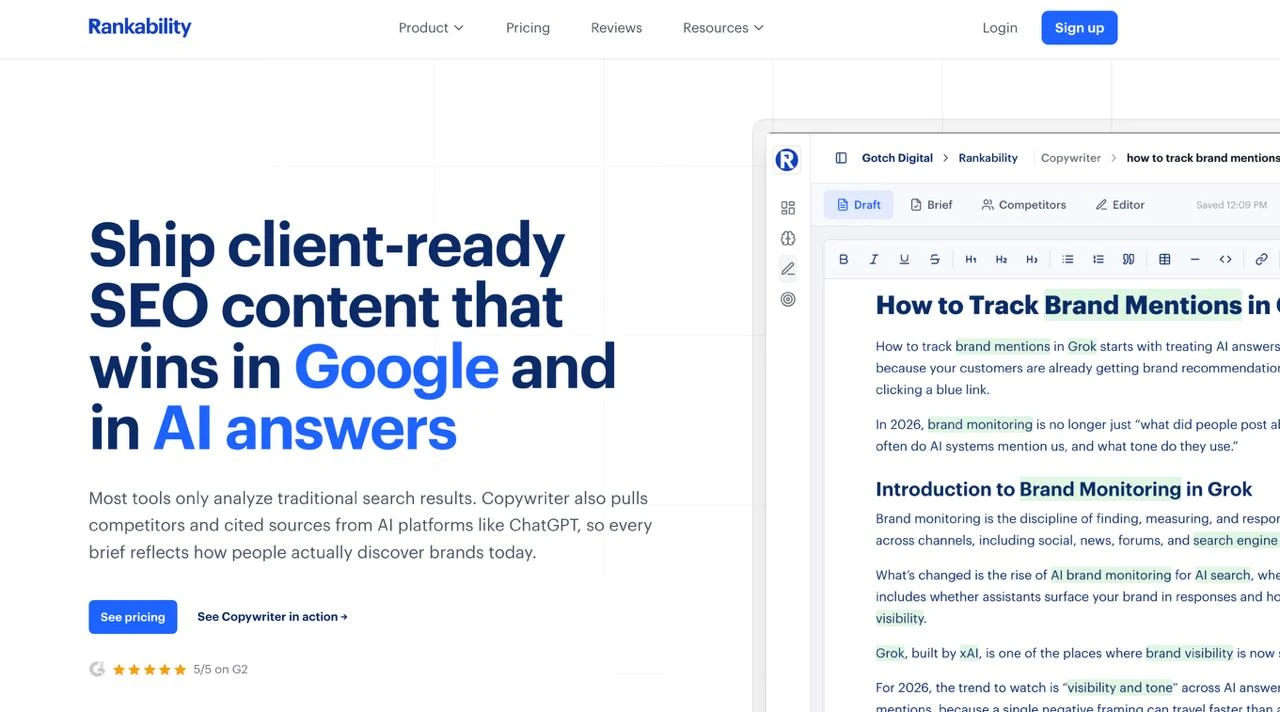
3. It delivers the work to your clients. Page and site audits feed into the same workspace, and white-label client reports pull in connected Search Console and Analytics data. Every paid plan includes unlimited client workspaces and team members, white-label reports, client keyword approvals, an MCP server with read and write access plus the API, a branded lead generator that turns your site into a source of marketing leads, and backlink monitoring.
Where it beats Ahrefs for agencies: AI visibility on 11 platforms is included, not a $199/mo add-on. Content creation and optimization is a core workflow, not a bolt-on. No per-seat fees. And it’s built for client delivery and reporting, which is exactly where the agency reviewer above said Ahrefs fell short.
Where Ahrefs is better: Rankability isn’t a backlink index. If your main job is deep link research or expired domain analysis, pair it with Majestic or keep a dedicated backlink tool.
Want to see if it fits your agency? Get started with Rankability. Plans start at $97/month with unlimited client workspaces and team members.
2. Semrush: Best full Ahrefs replacement
Best for: SEO professionals, digital marketing agencies, and enterprise teams that want the closest full replacement, plus PPC and AI search data. Starting price: SEO plan $139/mo ($117.33/mo annual). Starter $199/mo, Pro+ $299/mo, Advanced $549/mo. Free option: Free plan with 10 reports per day. 7-day free trial.
Semrush and Ahrefs are the two category leaders, and Semrush is the most-recommended Ahrefs alternative in every dataset I looked at. All 9 AI platforms named it, and it was the alternative reviewers mentioned most often (24 of the 163 negative Ahrefs reviews named Semrush, usually as the tool they were switching to).
It’s closer to an all-in-one marketing suite than a pure SEO tool. It covers keyword research, backlink analysis, site audits, position tracking, competitor research, SEO and PPC intelligence (organic and paid search, CPC, and ad data), and content tools. Its keyword gap tools and backlink gap reports show exactly where competitors beat you. It now includes AI visibility tracking in its SEO plans, including sentiment in AI-generated responses, with 50 to 200 prompts tracked daily depending on the tier.
Semrush also makes PageImprove, a Chrome extension that lets you push on-page technical fixes (titles, meta descriptions, canonicals, H1s) without waiting on a developer. Permanent changes still need to go into your CMS or codebase.
Where it beats Ahrefs: broader marketing coverage (PPC, local, content), cross-channel visibility, a free plan and trial, country and device segmentation, and data coverage Copilot cited at 27.9B keywords across 142 locations.
Where Ahrefs is still better: many SEOs still prefer Ahrefs’ backlink interface and filtering depth for link-heavy work. ChatGPT’s answer put it well: if backlinks are your central job, test Semrush alongside Ahrefs before canceling.
Watch out for: Semrush isn’t the low-cost option. Extra users start at $45/mo, and features like historical data and multi-location tracking require Pro+.
3. SE Ranking: Best value all-in-one
Best for: Agencies and value-focused teams. Starting price: Core $129/mo ($103.20/mo annual). Growth $279/mo ($223.20/mo annual). Free option: 14-day free trial, no credit card.
SE Ranking is the best value all-rounder for lean marketing teams and agencies. It delivers comparable keyword research, backlink analysis, daily rank tracking, and site audits. Its Core plan includes 2,000 tracked keywords and 100 AI prompts tracked daily, which is far more than Ahrefs Lite’s 750 keywords and 5 prompts at the same $129 price.
It also offers a Looker Studio connector, GA and Google Search Console data import, and API and MCP access, which makes it easy to fit into existing agency workflows.
Watch out for: white-label reporting is a separate Agency Pack add-on (+$69/mo, annual only), and expanded AI Search is another add-on (+$89/mo). For highly detailed link-profile analysis, Ahrefs is still the more specialized tool.
4. Search Atlas: Full suite with automation
Best for: Teams that want SEO automation in the same platform. Starting price: Starter $99/mo. Growth $199/mo. Pro $399/mo. Free option: 7-day trial (Growth adds free onboarding).
Search Atlas launched in 2024 and covers traffic, keyword, and backlink analysis, content optimization, technical audits, and LLM visibility tracking. Its OTTO feature handles workflow automation for on-site technical fixes, and its QUEST tool (marketed for ChatGPT visibility) traces the source documents GPTs reference so you can target them with outreach.
Watch out for: it uses a shared credit pool. Starter’s 50,000 Universal Credits cover about 1,500 rank checks or 50 AI articles, per Search Atlas’ pricing page. If credits are why you’re leaving Ahrefs, model your usage first.
For enterprise teams: Google AI Mode also named seoClarity for enterprise-scale SEO. It’s an enterprise platform with its own AI assistant, Sia, and custom pricing, so it’s built for large in-house teams rather than most agencies.
Alternatives for Backlink Data
Backlinks are where Ahrefs is still strongest, so this is where you should be most careful. Backlink data quality and filtering depth vary a lot between providers.
5. Majestic: Best dedicated backlink tool
Best for: Link builders, link building agencies, and backlink specialists. Starting price: Lite $49.99/mo. Pro $99.99/mo. API $399.99/mo. Free option: 7-day money-back guarantee on Lite and Pro for new customers.
Majestic does one thing: backlinks. Its Trust Flow and Citation Flow metrics are a useful second opinion next to Ahrefs’ DR for link quality assessment. Trust Flow scores domain-level trust attributes based on how close a site is to trusted seed sites, so it’s better at spotting spammy link profiles than raw link counts. Its Fresh Index covers links seen in the last 120 days.
The Pro plan adds the Historic Index, which gives you historical backlink data back to 2006. That’s useful for expired domain research and link audits. (Majestic notes the Historic Index was last updated in March 2024.)
Watch out for: there’s no keyword research or rank tracking, and the interface feels dated. API access sits behind a paywall on the $399.99 plan. (By comparison, Ahrefs now includes API and MCP access on every paid plan, so API paywalls are one place Ahrefs looks better than it used to.)
Why it fits Ahrefs refugees: limits are published as analysis units and report units. You know exactly what you’re buying, which is the opposite of the lockout complaints.
6. SEO PowerSuite: Best for heavy users who hate usage caps
Best for: Heavy users, link builders, and anyone burned by credit limits or lockouts. Pricing: Licensed by tier, with monthly and multi-year options. Check link-assistant.com for current pricing, since third-party sites list conflicting numbers.
SEO PowerSuite is a desktop SEO suite with four tools: Rank Tracker, WebSite Auditor, SEO SpyGlass (backlinks), and LinkAssistant (link outreach). Because you run it on your own machine, you aren’t charged per click the way Ahrefs credits work.
Watch out for: desktop software means it runs on your computer, and the interface takes some learning. It’s best for practitioners and solo operators, not for sharing with clients.
7. Moz Pro: Best for Domain Authority and beginner-friendly link analysis
Best for: Beginners, local SEO, and teams that report on Domain Authority. Starting price: Around $49/mo for Starter ($39/mo annual), per third-party listings. Confirm on Moz’s site.
Moz invented Domain Authority, the authority metric most clients still recognize, plus Page Authority and Spam Score. Many clients still ask for DA in reports. Moz Pro covers keyword research, link analysis (including new and lost links), site crawls, and rank tracking. The free MozBar browser extension shows DA and PA on any page.
Watch out for: it’s less of a fit when backlink research is your primary, high-volume job. The Starter plan only tracks 50 keywords.
Also worth knowing: Semrush has a full backlink toolset (covered above) and is the best backlink option if you want it inside an all-in-one suite. Ahrefs Webmaster Tools is free and still gives you Ahrefs backlink data for sites you’ve verified. Keep it even after you cancel. And if link audits are your main job, CognitiveSEO is another option that came up for backlink analysis and unnatural link detection.
Alternatives for Keyword Data
This is where you can save the most money. Keyword research is the most crowded category, and you don’t need Ahrefs-sized pricing to get reliable search demand estimates, keyword difficulty, and ranking potential.
8. Mangools: Best keyword tool for beginners and freelancers
Best for: Freelancers, bloggers, founders, and small sites. If you want the best cheap keyword tool with a user-friendly interface, start here. Pricing: Check Mangools’ pricing page. AI answers quoted anywhere from $19.90 to $37.70/mo, which tells you how often this changes. Refund: Full refund within 48 hours of payment.
Mangools is a five-tool bundle: KWFinder (keywords), SERPChecker, SERPWatcher (rank tracking), LinkMiner (backlinks), and SiteProfiler. KWFinder is one of the easiest keyword tools to learn. It works as a keyword generator and keyword checker in one, showing search volume, keyword difficulty, and SERP analysis on one screen.
Watch out for: SERPWatcher updates weekly except on the Agency plan, despite what some AI answers claim. It’s also not built to match Ahrefs’ link index or enterprise workflows.
9. Ubersuggest: Best cheap starter tool
Best for: Solopreneurs and small businesses on a tight budget. Pricing: Low-cost monthly plans plus a lifetime plan option. Check current pricing, since third-party listings conflict. Free option: Free plan limited to 3 searches per day.
Ubersuggest covers keyword ideas, content suggestions, basic site audits, backlinks, and rank tracking. One reviewer who switched from Ubersuggest to Ahrefs said they regretted canceling Ubersuggest.
Watch out for: data depth is lighter than Ahrefs or Semrush, and there’s no API plan.
10. SpyFu: Best for competitor PPC and ad history
Best for: PPC competitor research and businesses that run Google Ads. Pricing: Check SpyFu’s site. Third-party listings conflict.
SpyFu is built around competitors. It shows the keywords they rank and bid on, CPC data, plus years of ad history, so you can see which ad copy they kept running. Ahrefs isn’t focused on PPC competitor research.
SpyFu also makes RivalFlow AI, a content optimization tool that compares your existing pages against competitors’ content, runs a content gap analysis, and suggests content tweaks. It’s useful for fixing content decay on pages that are slipping.
Watch out for: it’s narrower than a full SEO suite, with lighter technical auditing and backlink tools.
11. Google Keyword Planner, Search Console, and Google Trends: Best free setup
Best for: Anyone who needs to start for $0. Price: Free.
- Google Keyword Planner gives you search volume ranges and keyword ideas straight from Google Ads data, filtered to the United States or any other country.
- Google Search Console shows the queries you already get impressions for. These are often the best keyword opportunities, because Google already associates you with them.
- Google Trends shows seasonal trends and topic momentum.
Add free question tools like Answer Socrates and Soovle for topic research, long-tail ideas, and questions that reveal user intent.
Watch out for: this setup isn’t a full Ahrefs replacement. You won’t get competitor keyword or backlink databases.
A note on local keywords: if you work with local businesses, don’t skip a city keyword because a tool shows zero volume. Every tool underreports geo-modified searches, Ahrefs included.
Also showed up in research: Keysearch (budget keyword research and difficulty), Serpstat (budget all-in-one with broad regional databases and API access, good for international SEO), and Sistrix (known for its visibility index, popular in Europe).
Alternatives for Tracking
Rank tracking got more complicated in the last two years. You now need to track rankings in three places: traditional search results, the local pack, and AI answers (including AI summaries like Google AI Overviews). Traditional SEO work still matters, but it’s no longer the whole picture. Ahrefs tracks the first well. It’s light on the other two unless you pay for Brand Radar.
12. Google Search Console (and Bing Webmaster Tools): Best free first-party tracking
Best for: Every website owner, with any other tool on this list. Price: Free.
This is the fix for the traffic estimate complaints. Search Console is first-party data: real clicks, impressions, average position, indexing coverage, and indexing errors straight from Google. It’s the most reliable tool for search performance monitoring on your own site. No third-party tool, Ahrefs included, can access that data. Bing Webmaster Tools does the same for Bing, which also matters because Bing’s index feeds several AI assistants.
Watch out for: you only see sites you’ve verified. It’s not competitor research.
For your own site: GSC + GA4 + Ahrefs Webmaster Tools (free) covers a lot of what small site owners were paying Ahrefs for.
Tracking options from tools already covered
- SE Ranking is the strongest pure rank tracker here: daily rank tracking, local and city-level positions, competitor ranking analysis, and agency-friendly packaging for local SEO workflows. Core includes 2,000 keywords.
- Rankability tracks Google, the local pack, and 11 AI platforms daily in one place, flags ranking shifts, and rolls it all into white-label reporting for clients.
- Semrush includes position tracking and AI visibility, with multi-location and device tracking on Pro+.
- Mangools SERPWatcher works for simple tracking, but updates weekly on most plans.
What to look for in AI search visibility tracking
If AI search matters to your clients (and it increasingly does), compare these before you buy:
| Ahrefs | Semrush | SE Ranking | Rankability | |
|---|---|---|---|---|
| AI prompts included on entry plan | 5 (Lite) | Included on SEO plan; 50/day on Starter | 100/day (Core) | 100 tracked queries (Starter) |
| Dedicated AI visibility add-on | Brand Radar AI from $199/mo | Separate AI Visibility toolkit | AI Search add-on from $89/mo | Included |
| AI platforms tracked | Varies by product | Multiple | Multiple | 11 |
Prompt counts and platform coverage change constantly. Check each vendor’s pricing page.
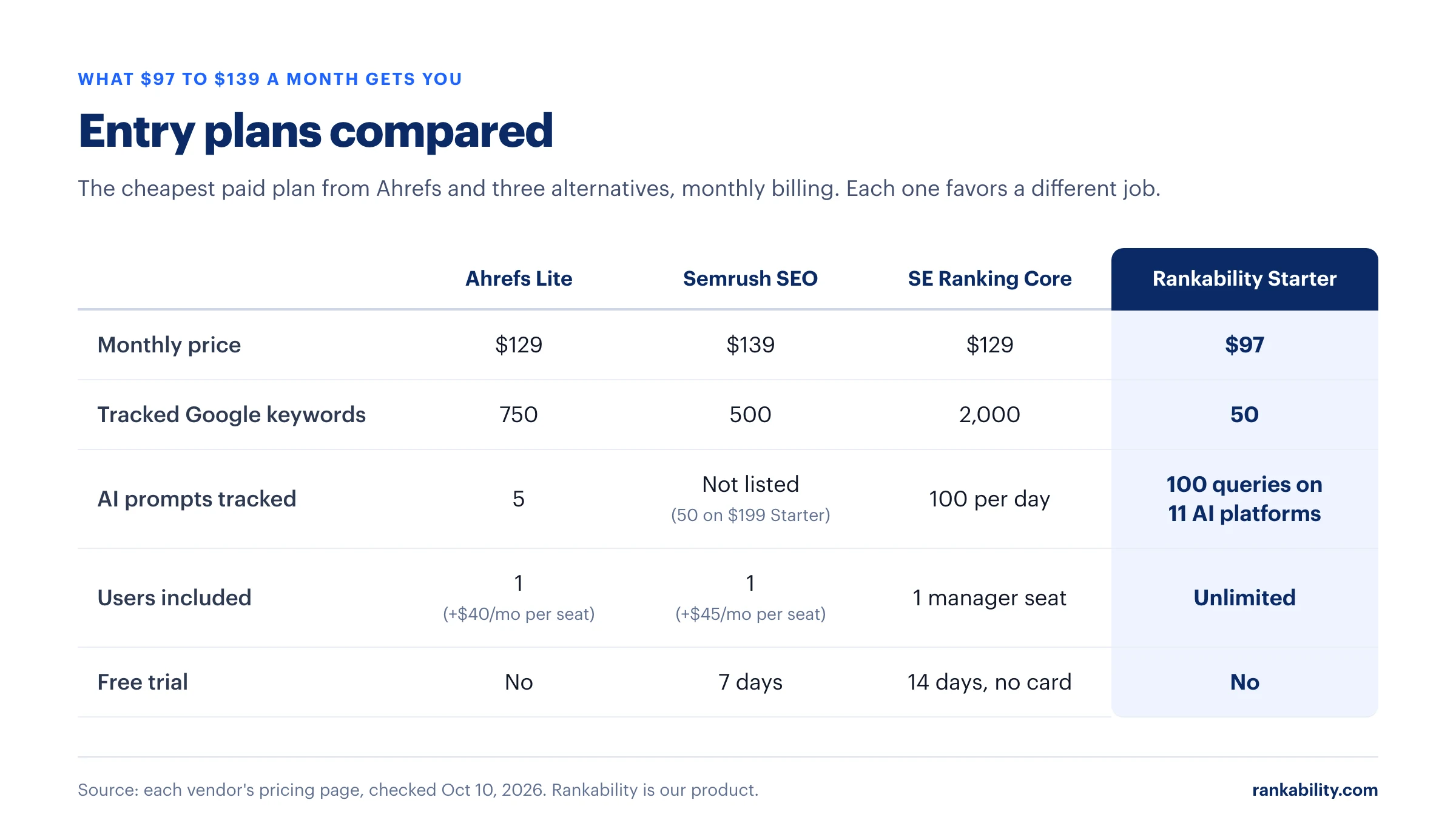
The cheapest paid plan from each, monthly billing. Each one favors a different job.
The questions that matter: which AI platforms does it track (ChatGPT, Gemini, Perplexity, Google AI Overviews, AI Mode, Claude, Copilot, Grok)? Does it show which source documents the AI cited? Does it show share of voice and competitive benchmarks against competitors? And does it tell you what to do next, or does it just give you a chart?
Alternatives for Auditing
Site audits got a small but specific set of complaints: one reviewer said Ahrefs’ crawler is blocked on so many sites that many errors were false positives, another said issues were hidden behind an upgrade, and two said the Site Audit tool was inconsistent.
13. Screaming Frog SEO Spider: Best technical SEO crawler
Best for: Technical SEOs and anyone doing serious audits. Price: Free up to 500 URLs. Paid licence $279 per year.
Screaming Frog is the industry-standard desktop crawler for page crawling and site health diagnosis. It finds technical SEO issues like broken links (broken link analysis), redirects and redirect chains (redirect analysis), status codes, duplicate pages, missing headings and meta descriptions, canonicals, XML sitemap and robots.txt file problems, internal linking checks, and structured data analysis. It also connects to GSC, GA4, and PageSpeed data, so you can find Core Web Vitals problems at scale.
Because it crawls from your own machine, you control the crawl. That avoids the “their bot is blocked” problem one reviewer described.
Watch out for: it gives you data, not prioritization. You need to know what matters.
Free and lightweight audit options:
- Ahrefs Webmaster Tools: free Ahrefs Site Audit for verified sites.
- SEO Minion: free Chrome extension for on-page checks, redirect checks, and SERP previews.
- Seobility and SEOptimer: budget audit tools with easy-to-read reports.
- WebCEO: audits plus white-label reporting for agencies.
Semrush, SE Ranking, Moz Pro, and Rankability all include site audits too. Rankability’s audits feed straight into the task list and client reports, so findings become work instead of sitting in a dashboard.
Alternatives for Content
Ahrefs added AI content tools, but content optimization isn’t what most people buy it for.
For agencies, my top pick here is Rankability (#1 above). It’s the only tool on this list that combines all four: it researches both Google and AI answers, builds an entity checklist with source evidence, drafts in the client’s brand voice with a fact-checking step, and publishes straight to WordPress or Webflow. See the full breakdown in the Rankability section.
If you only need a scoring tool for writers, these two are the best standalone options.
14. Surfer SEO: Best for on-page content optimization
Best for: Content teams optimizing articles while they write. Starting price: Discovery $49/mo (billed yearly). Standard $99/mo, Pro $182/mo (billed yearly).
Surfer scores your draft against the pages already ranking and tells you which terms, entities, headings, and topics to add. Entity analysis like this helps you build topical authority, though it’s no substitute for real E-E-A-T signals like first-hand experience and source-backed statistics. It includes a content editor, content audit, and higher plans add AI tracking (25 prompts refreshed weekly on Standard, 50 daily on Pro).
Watch out for: it’s a strong supplement, not a full Ahrefs replacement. There’s no backlink database.
15. Clearscope: Best for teams that want simple content grading
Best for: Content marketers and editorial teams. Starting price: Essentials $129/mo. Business $399/mo. Free option: 14-day free trial.
Clearscope is the simplest content optimization tool to roll out to writers. All plans include unlimited users, which matters if you’ve been paying Ahrefs per seat.
Watch out for: it’s priced like a premium tool for a single job.
Other content options:
- Semrush has the SEO Writing Assistant and ContentShake AI.
- Rank Math SEO and Yoast SEO handle on-page basics inside WordPress.
- BuzzSumo is useful for content ideas and finding linkable assets: the content in your niche that gets shared and linked.
- Writesonic is an AI writing tool with SEO features.
- RankDots groups keywords into topic clusters by intent classification, competition, and topical depth, then helps with content planning.
- Contentpen is an AI content platform with SERP and gap analysis, SEO scoring, and a WordPress plugin.
- Distribb automates keyword research, publishing to your CMS, and content distribution to social channels.
One caution with the AI content creation tools: they speed up your content process, but they don’t replace editorial judgment. Review every draft before it goes live.
Bonus: Alternatives for Traffic and Market Intelligence
Since traffic estimates are one of the loudest Ahrefs complaints, this deserves its own section.
Similarweb is the best-known digital market intelligence platform, built for market and traffic intelligence. Instead of estimating search traffic from keyword rankings alone, it focuses on traffic sources, traffic mix, referral flows, audience behavior, customer journeys, and market share analysis across channels. That makes it better competitive intelligence for questions like “how big is this competitor?” or “where does their traffic come from?”
It’s priced well above most SEO tools. And it’s still estimated data, so the same rule applies: treat competitor traffic numbers as direction, not fact.
The Best Free Ahrefs Alternatives (A $0 Tool Stack)
If budget is the main reason you’re leaving, here’s a stack that costs $0:
| Job | Free tool |
|---|---|
| Your own backlinks and audit | Ahrefs Webmaster Tools |
| Your own rankings, clicks, and indexing | Google Search Console, Bing Webmaster Tools |
| Traffic and conversions | Google Analytics 4 |
| Keyword ideas and volume | Google Keyword Planner, Google Trends, Answer Socrates, Soovle |
| Competitor snapshots | Semrush free plan (10 reports/day), Ubersuggest free plan (3 searches/day) |
| Technical crawl | Screaming Frog (up to 500 URLs) |
| On-page checks | SEO Minion, MozBar |
| WordPress on-page | Rank Math or Yoast |
| Reporting | Looker Studio |
| Classic free SEO tools | SEOBook’s free tools (dated, but still handy for quick checks) |
This won’t replace Ahrefs for competitor research. But for a single site, it covers more than most people expect.
How to Choose the Right Ahrefs Alternative
Step 1: Name the job. Look at the last month in Ahrefs. Which reports did you open most? Backlinks, keywords, rank tracking, audits, or content? Start there.
Step 2: Match your reason for leaving. If you’re leaving over credits, don’t move to another credit-based tool without modeling your usage. If you’re leaving over lockouts, choose desktop software or ask the vendor for limits in writing.
Step 3: Pick a tool with a real trial. SE Ranking (14 days, no card), Semrush (7 days), Clearscope (14 days), Search Atlas (7 days), and Majestic (7-day money back) all let you test before you commit. Run the same 10 keywords and 3 competitor domains through each one.
Step 4: Keep the free tools. Search Console, GA4, and Ahrefs Webmaster Tools should stay in your stack no matter what you choose.
Step 5 (agencies): Think about delivery, not just data. Your clients don’t pay for a backlink count. They pay for rankings, leads, and visibility in AI answers. Choose the stack that gets you from data to delivered work, with reports your clients will actually read.
FAQs
What is the best alternative to Ahrefs?
For agencies, Rankability is the best alternative if you need AI search visibility, content creation and optimization, and client reporting in one place. If you want the closest feature-for-feature replacement, choose Semrush. It was recommended by all 9 AI platforms I analyzed and was the alternative most often named by unhappy Ahrefs reviewers. SE Ranking is the best value all-in-one.
Is there a free alternative to Ahrefs?
There’s no free tool that replaces Ahrefs completely. The best free setup is Google Search Console, Google Analytics 4, Google Keyword Planner, and Ahrefs Webmaster Tools (which stays free for sites you verify). Add Semrush’s free plan and Screaming Frog’s free version for competitor snapshots and crawls.
Which tool is most similar to Ahrefs?
Semrush. It matches Ahrefs feature for feature across keyword research, backlinks, audits, rank tracking, and competitor research, and adds PPC and broader marketing tools.
What is the best Ahrefs alternative for backlinks?
Majestic is the best dedicated backlink tool, with Trust Flow, Citation Flow, and a historic index back to 2006. SEO PowerSuite’s SEO SpyGlass is the best choice if you do high-volume link work and want to avoid usage caps. Semrush is the best backlink option inside an all-in-one suite.
Why is Ahrefs so expensive?
Ahrefs runs one of the largest web crawlers in the world, and that infrastructure is expensive. But the bigger issue for most reviewers wasn’t the sticker price. It was the extras: credits on Lite, $40 to $80 per extra seat, AI visibility as a separate $199/mo product, and features like history and higher limits gated to higher tiers.
Are Ahrefs traffic estimates accurate?
They’re estimates of organic traffic only, based on keyword rankings, and Ahrefs says so. Reviewers have reported gaps of 20x or more against their own analytics. Use Google Search Console and GA4 for sites you own, and treat any third-party traffic number as directional.
Why does Ahrefs say “suspicious activity detected”?
Ahrefs applies automatic restrictions when usage patterns exceed what it considers typical human activity, including on its “unlimited” plans. It doesn’t publish the triggers, and support can’t lift the restriction manually. Restrictions are temporary, but reviewers reported lockouts lasting from hours to two weeks.
Does Ahrefs offer a free trial or refunds?
Ahrefs doesn’t offer a free trial. It has a free plan (Ahrefs Webmaster Tools) for verified sites and a $29/mo Starter plan. Several reviewers reported being denied refunds once they had used the product. If you want to test before committing, SE Ranking, Semrush, and Clearscope all offer free trials.
Do I still need Ahrefs if I use Semrush or SE Ranking?
Most people don’t. If deep backlink research is your main job, many SEOs keep one backlink tool alongside an all-in-one. Either way, keep Ahrefs Webmaster Tools. It’s free.
Conclusion
Ahrefs is still a great data tool. But after reading 163 complaints, the pattern is clear: people don’t leave because the data got bad. They leave because the way they pay for it stopped matching how they work, whether that’s credits that vanish in two days, “unlimited” plans that lock them out, or a bill that doubles when a legacy plan ends.
So don’t swap one tool for another blindly. Name the job, match it to your reason for leaving, and test with a real trial.
And if you’re an agency that needs to track clients across Google, the local pack, and AI search, then create the content that moves those numbers and report on it, get started with Rankability.