

Research Finding
Based on analyzing 1,536 Google search results, we found no consistent correlation between keyword density and ranking. The segment averages below do not establish an algorithmic weight or optimal density. Relevant language remains useful for explaining a topic.
The Average Keyword Density for Top 10 Google Results is 0.04%
The table summarizes the original analysis of 1,536 results across 32 highly competitive keywords. It contains segment averages, not the complete page-level dataset:
| Ranking Segment | Average Keyword Density |
|---|---|
| 1-10 | 0.04% |
| 11-20 | 0.07% |
| 21-30 | 0.08% |
| 31-40 | 0.06% |
| 41-48 | 0.04% |
The pattern is not monotonic: both positions 1–10 and 41–48 have a reported average of 0.04%, while the middle segments are higher. These averages do not establish an optimal density or show that lowering density improves rankings.
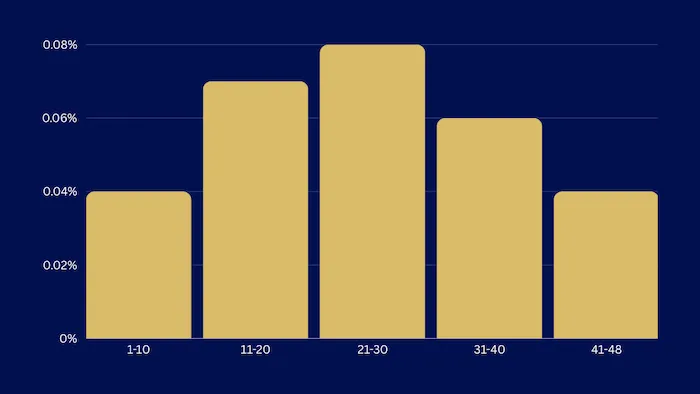
Measurement limitation: These are the percentages reported in the original study. The page-level data and calculation definitions are not reproduced here, so the figures should not be converted into a keyword-frequency target. This review does not represent a new experiment.
Important Considerations
However, it’s important to note a few key points:
- Limited Dataset: The averages may not represent all keywords and domains accurately.
- Correlation vs. Causation: The graph shows a correlation, not causation. Lower keyword density doesn’t automatically lead to higher rankings; it might simply be a characteristic of high-quality content that is naturally written and user-focused.
- Multifaceted SEO: Google’s ranking algorithm considers many factors beyond keyword density, such as content quality, user experience, backlinks, and more. A holistic approach to SEO is generally more effective.
- Risk of Under-Optimization: An excessive focus on lowering keyword density can lead to content that is not sufficiently optimized for search engines. It’s crucial to strike a balance, ensuring that keywords are used effectively to maintain SEO value while prioritizing natural, reader-friendly content.
- Context and Relevance: The context and relevance of keywords within the content are more important than the sheer number of keywords.
The top and bottom segments report the same average. Focus on quality and relevance rather than treating this table as a density target.
AI citation data points in the same direction: 94.3% of analyzed page bodies lacked the complete search query, and repeating the phrase more often showed no independent citation-position advantage after accounting for relevance.
What Google says about keyword density
Google’s spam policies prohibit keyword stuffing: unnatural repetition intended to manipulate rankings. They do not provide a safe percentage threshold. Use the language readers expect, but do not repeat terms to satisfy a density score.
Best Practices for Keyword Usage
Focus on Natural Writing
Write for your audience first, search engines second. Use keywords naturally within the context of helpful, comprehensive content.
Prioritize Content Quality
Create content that thoroughly addresses user intent and provides genuine value rather than targeting specific keyword density percentages.
Use Semantic Variations
Include related terms, synonyms, and contextually relevant phrases rather than repeating the exact keyword.
Avoid Keyword Stuffing
Don’t force keywords into content where they don’t naturally fit. This can harm both user experience and rankings.
If a ranking decline follows a Google update, work through the Google Spam Update Checklist to rule out keyword stuffing and other documented spam-policy risks.
Monitor User Engagement
Focus on metrics like time on page, bounce rate, and user satisfaction rather than keyword density percentages.
Conclusion
The reported segment averages do not show a consistent relationship between keyword density and ranking, and they do not isolate cause and effect. The 0.04% top-segment average is a historical observation, not an optimization target. Write naturally, answer the query, and avoid manipulative repetition regardless of its percentage.